
Singer Electric, in partnership with ABB and Auckland Transport (AT), has delivered a ground-breaking maritime charging solution at Auckland’s Half Moon Bay — marking the commissioning of New Zealand’s first Megawatt Charging System (MCS) for electric ferries.
This milestone completes the first phase in a staged electrification programme and represents a significant step forward for New Zealand’s public transport network.
Although the ferry cannot begin commercial service until a second charger is installed at the Downtown Ferry Terminal (due in 2026), the Half Moon Bay site is now commissioned and undergoing sea trials — establishing critical infrastructure and learnings for the broader rollout of electric marine transport in Aotearoa.
Project Overview
The goal of the project is to demonstrate a viable, scalable, and emissions-free alternative to diesel ferries on Auckland’s busy harbour network. Auckland’s ferry fleet currently emits around 15,000 tonnes of CO₂ annually, and this project represents a critical step toward reducing that footprint.
Electrification is expected to deliver long-term benefits — including lower emissions, reduced noise pollution, and improved operational efficiency.
The first sites to be enabled for ferry charging are: Half Moon Bay (now complete) and the Downtown Ferry Terminal (under development). Together, these sites will allow the launch of Auckland’s first electric passenger ferries, connecting East Auckland with the city centre.
The project was delivered through a coordinated partnership, including:
- Auckland Transport (AT) — Client / Asset owner
- ABB — Supplier of Megawatt Charging System (MCS) technology, including converters and power cabinets
- Singer Electric — New Zealand-based engineering, integration, and installation partner for all shore-side electrical infrastructure
- Entec – E-House design-build
Each partner brought specialised capabilities to deliver a complete, interoperable system that meets global standards for safety, efficiency, and future scalability.
System Design and Delivery
This installation marks the first ABB Megawatt Charging System deployed in a maritime setting in New Zealand — and one of the earliest deployments worldwide. It serves as a real-world test for technical feasibility, port-side integration, and long-term interoperability with ferry-side charging systems.
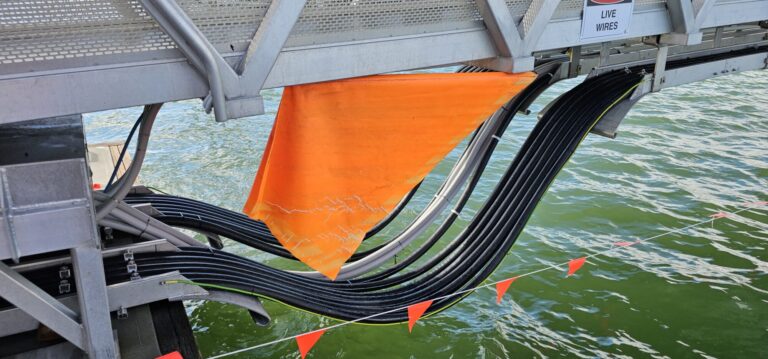
The system at Half Moon Bay features two 1.65MW ABB MCS plugs delivering a combined 3.3MW of high-capacity charging. Singer Electric was responsible for the project management and installation in New Zealand.
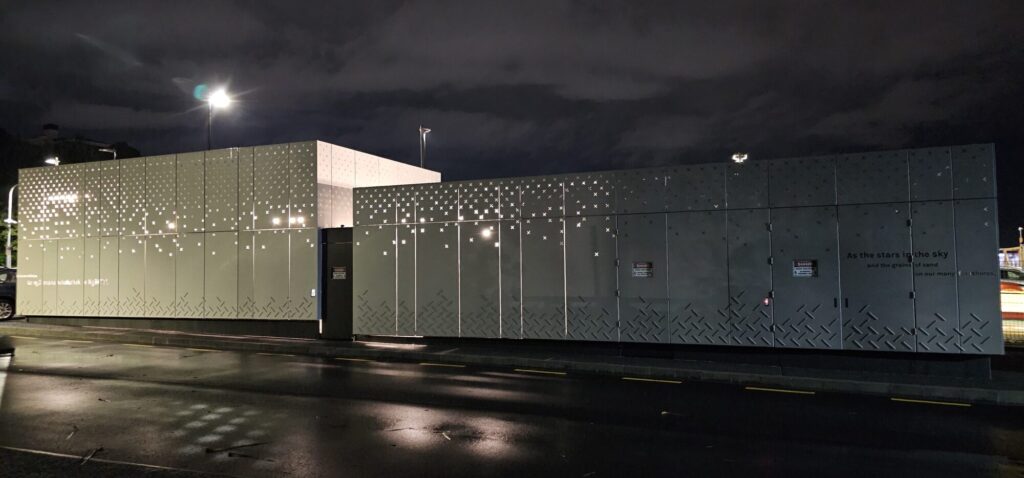
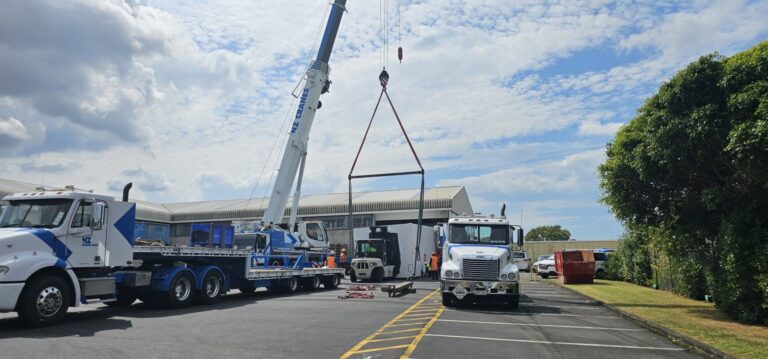
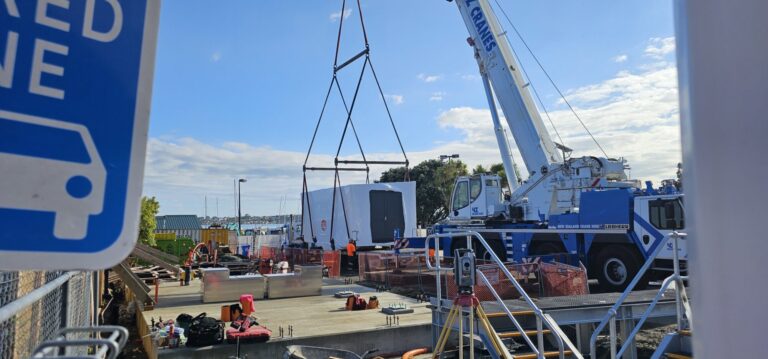
At the heart of the installation is a containerised eHouse, designed and built by Entec with input from Singer and all other parties. Pre-fabricated off-site and delivered as a complete unit, it houses all key components, rectifiers, switchgear, and cooling, in a weatherproof, secure, and visually integrated unit.
“It’s all pre-tested and wired up before it arrives,” said Finn McLaren, Head of Sales & Marketing at Singer. “From an install perspective, you just crane it in, connect the feeds, and you’re good to go. That means faster installs, less disruption to the site, and much less risk.”
The eHouse is also designed to match the local wharf environment, with lighting and design elements created with design input from Iwi, Ngāti Whātua Ōrākei that make it an aesthetically fitting addition to the public space.
Proven Partnership
As ABB’s NZ Channel Partner, Singer Electric has played a key role in bringing high-current charging to the local market.
“ABB’s gear is world-class — and they’ve led the charge in MCS technology globally,” said Finn McLaren. “But bringing that into a real port environment takes local know-how. That’s where we come in.”
He said the ABB-Singer partnership is a model for how infrastructure electrification can move faster — with one team responsible from end to end.
“For a business or council trying to decarbonise, there’s already a lot to navigate — networks, standards, marine rules, engineering, procurement, build… Our goal is to help make all of that simple.”
Singer Electric and ABB have worked together on multiple large-scale electrification projects across New Zealand — including the recently completed Glenfield depot, one of the country’s high-capacity electric bus depots, which supports up to 34 electric buses.
The Half Moon Bay ferry project builds on this proven partnership, combining ABB’s globally recognised charging hardware with Singer’s deep local expertise in complex infrastructure delivery. This is the first multi-megawatt project delivered in a marine setting in New Zealand.
As ABB’s certified reseller and installation partner in New Zealand, Singer brings end-to-end capability — from design and engineering through to installation, commissioning and ongoing service support. The company specialises in integrating high-voltage systems in operational environments, with a strong focus on modularity, futureproofing and fast delivery.
“This isn’t just about installing a charger,” says Finn McLaren. “It’s about designing safe, smart infrastructure that works in the real world — and having one partner to manage the process makes it simpler and lower-risk for the client.”
What’s Next
The Half Moon Bay charger is now being monitored to track its performance under real-world conditions — including thermal regulation, component durability, and ongoing power demand.
Finn McLaren says the same containerised approach used here could be applied to other ports, commercial operators, or industrial transport systems. Singer has already received interest from overseas, including from Spain.
“It’s a clean, modular solution that you can pick up and drop into different use cases. We’ve proven it here, and there’s no reason it couldn’t go further.”
With the eHouse commissioning now complete and ferry testing underway, the project has already proven its primary goal: high-speed electric marine charging is viable, practical, and scalable in New Zealand. The Downtown chargers are due in late 2026 for Pier 4, with Piers 5 and 2 following in 2027.
“The Half Moon Bay deployment has proven that this system is both technically robust and operationally practical,” said Nathan Cammock, Programme Director, Low Emission Ferry Programme at Auckland Transport.
“The containerised eHouse design allowed for safe, rapid installation in a constrained public marine environment. This approach gives us a scalable, replicable model for ferry electrification across the network,” Cammock said.
(ends)
Further Information
For more information on the Singer ABB MCS charging solution, contact:
Finn McLaren: Head of Sales & Marketing, Singer Electric
Finn McLaren; 021 0293 0318;